USA Local SEOGuide
SEO Services in the USA: A Local & Organic Growth Guide for American Businesses
How SEO actually works for US businesses in 2026 — local search, technical foundations, content, and a practical way to plan the first 90 days.
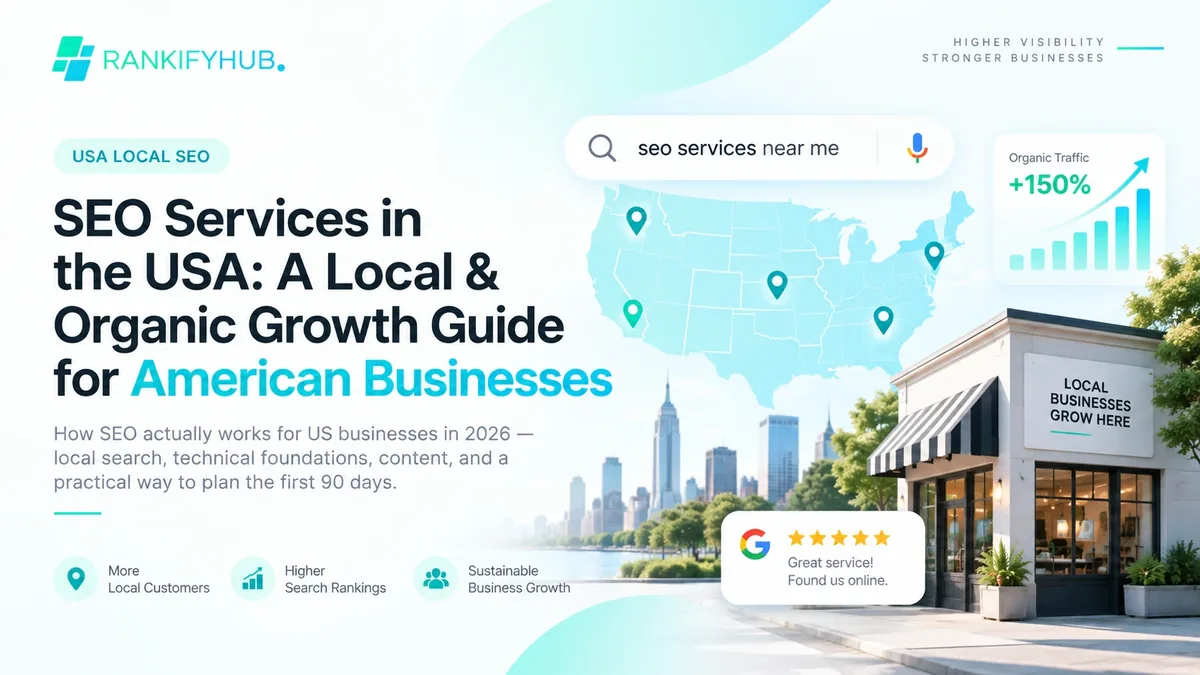
How SEO actually works for US businesses in 2026 — local search, technical foundations, content, and a practical way to plan the first 90 days.
Most US businesses looking for SEO help are really asking two different questions at once: “how do I show up when someone nearby searches for what I do” and “how do I build organic visibility that compounds over time instead of resetting every month.” Local search and organic SEO overlap, but they’re not the same discipline, and a plan that treats them as one thing usually under-serves both.
This is a practical breakdown of what actually matters for a US-based business evaluating SEO — not a pitch for a specific number of keywords or a promised ranking position. No SEO provider, including RankifyHub, can guarantee a first-page ranking; anyone who does is selling a promise they can’t control, since ranking is ultimately Google’s decision, not the agency’s.
For a business with a physical service area — a clinic, a law firm, a home-services company, a retail location — local search is usually the higher-leverage starting point. That means:
Organic SEO — ranking for informational and broader commercial searches that aren’t tied to “near me” intent — depends more on site architecture, content depth, and technical health. A national or multi-location business usually needs both tracks running in parallel, weighted differently depending on how much of its revenue is genuinely local-service-driven versus broader e-commerce or lead generation.
Content and links get most of the attention in SEO conversations, but a technically broken site limits everything built on top of it. The core checks:
A useful way to plan content is to follow the real search journey rather than a single target keyword:
Most sites over-invest in stage 3 content and under-invest in stage 1 and 2 — which is a problem, because stage 3 pages have the smallest addressable audience and the most competition. A durable content plan covers all three stages and links them together deliberately, rather than publishing isolated pages that never reinforce each other.
This is a general framework, not a guarantee of results in any specific timeframe — actual pace depends on the site’s starting condition, competition, and how quickly technical/content work can ship.
Days 1–30: Foundation. Technical audit (crawlability, indexation, site speed, mobile usability), Google Business Profile completeness check, and a content gap analysis against what’s actually ranking for the target market today.
Days 31–60: Execution. Fix the technical issues that block indexing or hurt page experience. Publish or rewrite the highest-priority pages identified in the gap analysis. Build out internal linking so new and existing pages reinforce each other instead of competing.
Days 61–90: Expansion and measurement. Extend into stage 1/2 content that supports the commercial pages already live. Review what Search Console data is actually showing — impressions, click-through rate, and query data — and adjust the plan based on real signal instead of assumptions.
Is SEO still worth it with AI Overviews and AI-driven search changing how results show up? Yes, but the fundamentals haven’t changed — a page still needs to be crawlable, genuinely useful, and clearly structured to be eligible for any of it, including AI-generated summaries. There’s no separate trick that bypasses good SEO; AI search features are built on the same indexed content.
How is this different from just running ads? Paid search buys visibility for as long as the budget runs. SEO builds visibility that keeps working (with maintenance) after the initial investment, which is why most businesses that can afford it run both — ads for immediate demand capture, SEO for compounding, lower-marginal-cost visibility over time.
Do I need separate strategies for each city or location I serve? Only where there’s genuine reason to — real differences in service area, local competition, or audience. Publishing near-identical pages with only the city name swapped is a pattern search engines are explicitly built to discount, and it tends to hurt more than it helps.
If you’re trying to figure out whether the issue is technical, local, or content-related, a Free Strategy Audit is the fastest way to get a specific answer instead of a generic checklist — RankifyHub’s team reviews the actual site and Business Profile and comes back with what’s genuinely limiting visibility, not a templated report. For a direct conversation, a 30-minute call is also available any time.
Free Digital Growth Review
See where your digital presence is losing visibility, trust, or opportunities — and get a clear plan for what to improve next.
7+
Years in Digital Marketing
Full-Scale
Digital Marketing Support
FREE
Local Citation
Currently supporting multiple immigration law projects across SEO, websites, paid ads, local search, content, and lead generation.
Explore Immigration Law Firm MarketingSpeak with the RankifyHub team about your website, visibility, ads, or growth goals.
Chat on WhatsAppSecure • No Spam • Your Information Stays Private
The RankifyHub team has received your details. We'll review your request and follow up with the most relevant next step.